Inside Kenya’s 3 Most Disturbing Mass Grave Discoveries
Kenya has been hit by a series of disturbing mass grave discoveries in recent years, sending shockwaves through the public conscience
Kenya has been hit by a series of disturbing mass grave discoveries in recent years, sending shockwaves through the public conscience and raising urgent questions about accountability, governance, and the protection of human life.
The recent discovery of mass graves in different parts of Kenya sent shock waves across the country, where every revelation raised the same unsettling question: how could such a large-scale loss of life go unnoticed, or without immediate intervention?
Each investigation presented authorities with gruesome scenes that required lengthy forensic work, multi-agency coordination, and protracted efforts to establish identities, causes of death, and possible accountability.
1. Mass graves in Shakahola
The discovery of mass graves in the Shakahola Forest in Kilifi County is among the most tragic events in Kenya’s history.
The issue first emerged in April 2023 when intelligence about suspicious activities tied to a religious group led security agencies to rescue some people from a remote part of the forest.
Investigators quickly zeroed in on preacher Paul Mackenzie, the head of Good News International Ministries.
Administrations accused Mackenzie of telling his followers to practice extreme fasting to achieve spiritual salvation and meet Jesus. What had started as a small religious disagreement rapidly became a national tragedy.
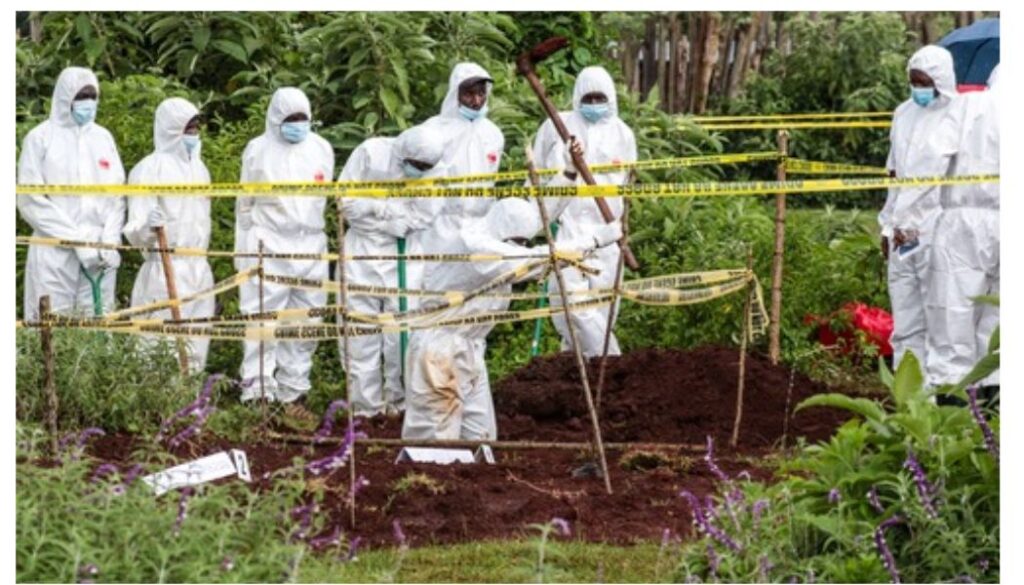
As the search continued, investigators discovered several shallow graves hidden throughout the large forest.
The discovery’s magnitude stunned not only the public but also government officials. Hundreds of bodies were recovered over several months of exhumation exercises.
It is one of the deadliest incidents associated with a religious movement in modern African history.
By the end of 2023, officials said they had exhumed more than 400 bodies from the site. Many of the victims, forensic examinations indicated, seem to have died of starvation.
But some post-mortems have indicated signs of possible suffocation, strangulation, and other violence, raising fears that not all the deaths were caused by fasting alone.
The case has sparked intense national debate over the regulation of religious organizations and the protection of vulnerable individuals from exploitation.
Mackenzie and several of his associates were arrested and subsequently faced a series of charges, including murder and terrorism related offences.
Authorities continue to investigate, and court proceedings are ongoing as they try to piece together what happened in the remote settlement.
2. Discovery of the Kware Dumpsite
One year and one month after the Shakahola tragedy, another disturbing discovery was made in the Kware area of Embakasi, Nairobi.
Unlike the Shakahola case, which was associated with a religious group, the Kware incident has sparked fears of serial killings and possible links to missing persons cases.
In July 2024, police officers discovered multiple mutilated bodies dumped in sacks at a local dumpsite.
Residents and human rights activists had voiced worries after witnessing odd activities in the area and tying them to reports of people who went missing in mysterious circumstances.
The condition of the bodies was horrific, and there was public outrage. Many Kenyans demanded immediate investigations, and human rights groups demanded transparency and accountability, expressing fears that some of the victims may be linked to cases of enforced disappearances or extrajudicial killings.
The Directorate of Criminal Investigations (DCI) launched a full investigation into this.
Collins Jumaisi was arrested as a suspect on July 15, 2024, authorities said.
The 33-year-old was picked up during a joint operation between DCI officers and the National Police Service, according to the investigators.
The suspect confessed to killing 42 women between 2022 and July 2024, DCI Director Mohamed Amin told a press conference.
The victims, the investigators said, were lured, killed, and their bodies dumped at the dumpsite.
Authorities further claimed that the suspect’s actions were motivated by personal resentment over his wife’s unsuccessful economic endeavors.
Police reports state that he claimed to have killed his wife before carrying out a string of killings over an extended period of time.
When Jumaisi and a number of other inmates allegedly broke out of the Gigiri Police Station in August 2024, the story took yet another unexpected turn.
His escape sparked new worries about the criminal justice system’s security flaws.
He had not been taken into custody again at the time of publishing, raising a number of unresolved issues regarding one of Kenya’s most unsettling criminal investigations.
3. Kericho Mass Grave Discovery
In March 2026, two street children who worked as grave diggers reported suspicious activity at the Makaburini public cemetery, prompting police officers from Kericho Police Station, along with investigators from the Directorate of Criminal Investigations and scenes-of-crime personnel, to visit the site. Upon inspection, authorities discovered what appeared to be a recently dug grave within the cemetery grounds.
This incident garnered national attention, this time in Kericho County.
Under the direction of government pathologists and homicide detectives, investigators began a thorough exhumation operation after the discovery.
According to early sources, there may be about 14 people buried there. But as excavation work continued, the discovery’s scope turned out to be much more than first thought.
In the end, authorities verified that 33 remains had been recovered from the grave.
According to preliminary evaluations, eight of the deceased were thought to be adults, while twenty-five were thought to be youngsters.
Because of the abnormally high proportion of juveniles among the victims, the findings quickly caused public concern.
Forensic specialists were still attempting to identify the found individuals and ascertain the precise circumstances of their deaths at the time of reporting.
Additionally, investigators started looking into the possibility that criminal activity, procedural flaws, or institutional shortcomings contributed to the graves.
Authorities are still actively investigating the Kericho case in an effort to provide a clear explanation for how the dead ended up in the public cemetery.