Ibrahim Traoré Urges Nation to Move Beyond Democracy
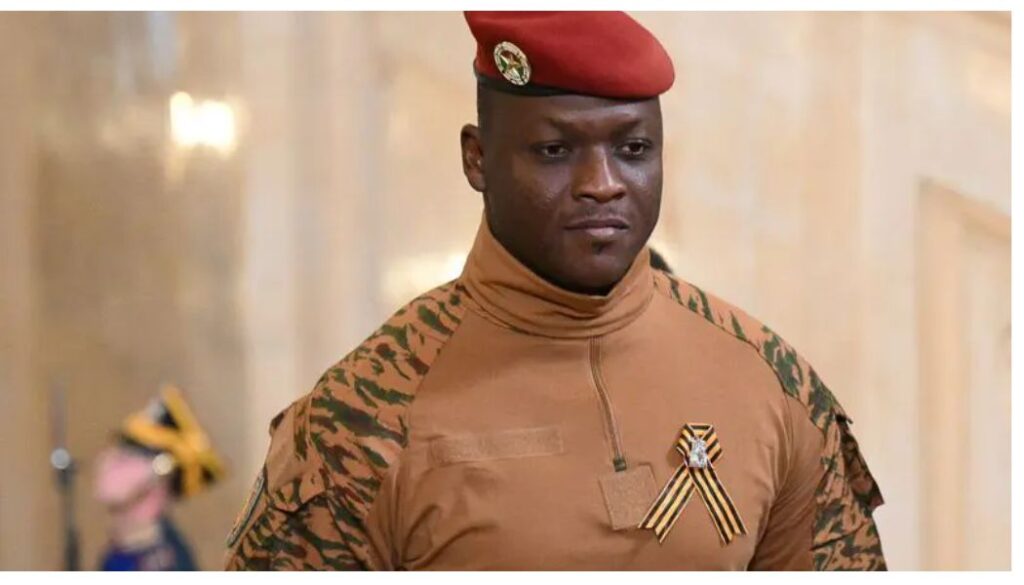
Burkina Faso’s interim leader, Ibrahim Traoré, has sparked fresh debate after publicly dismissing democracy as unsuitable for his country
Burkina Faso’s interim leader, Ibrahim Traoré, has sparked fresh debate after publicly dismissing democracy as unsuitable for his country. In a televised interview aired on state media, the military captain urged citizens to abandon the idea of democratic governance, describing it as harmful rather than beneficial.
The remarks come at a time when political life in Burkina Faso has been significantly restricted. Earlier this year, the ruling junta dissolved political parties and halted formal political activities, tightening its control over the nation’s governance.
Traoré’s comments appear to reinforce this direction, signaling a long-term shift away from democratic structures.
Traoré, who rose to power in September 2022 following a coup, has consistently framed democracy as an imported concept that does not align with Burkina Faso’s realities.
The coup itself removed former president Roch Marc Kaboré, who had been elected through a democratic process.
Since then, Traoré has positioned his leadership as a break from previous systems.
In the interview, he argued that democracy often leads to instability and conflict, rather than peace and development.
According to him, attempts to establish democratic systems in various parts of the world have frequently been accompanied by violence.
He pointed to neighboring Libya as an example, suggesting that political transitions there have resulted in prolonged unrest.
Traoré’s rhetoric goes further than criticism, portraying democracy as fundamentally incompatible with his country’s needs. He insisted that Burkina Faso must forge its own governance model, rather than adopt systems developed elsewhere.
In his view, the country is undergoing a transformation aimed at redefining how power is organized and exercised.
Initially, the junta had promised a return to civilian rule by mid-2024. However, shortly before that deadline, authorities announced an extension of military governance for an additional five years.
This move raised concerns among observers both within the region and internationally, as it signaled a delay in restoring electoral processes.
The government has also taken concrete steps to consolidate its authority.
In January, more than 100 political parties were banned, and their assets were taken over by the state. Prior to this, parliament had already been dissolved, effectively removing legislative oversight.
The electoral body responsible for organizing votes was also disbanded in 2025, with officials claiming it was too costly to maintain.
Despite these developments, Traoré maintains that his administration is not attempting to replicate any existing political model. Instead, he emphasizes the creation of a system tailored specifically to Burkina Faso’s circumstances. He argues that this approach is necessary to address the country’s ongoing challenges, including security concerns and governance issues.
Across Africa, military takeovers have become more frequent in recent years, though democratic elections remain the norm in most countries. In some cases, military leaders have organized elections after seizing power, later transitioning into civilian leadership roles themselves.
However, Burkina Faso’s current trajectory appears to diverge from that pattern.
Traoré’s statements are likely to intensify discussions about governance and political legitimacy in the region. While some supporters view his approach as a rejection of ineffective systems, critics warn that abandoning democratic principles could limit accountability and public participation.
As the country moves forward under extended military rule, the long-term implications of this shift remain uncertain. What is clear, however, is that Burkina Faso is entering a period of significant political change—one that challenges widely accepted ideas about democracy and governance.